
Florida Undergraduate Research Conference
February 22-23, 2020
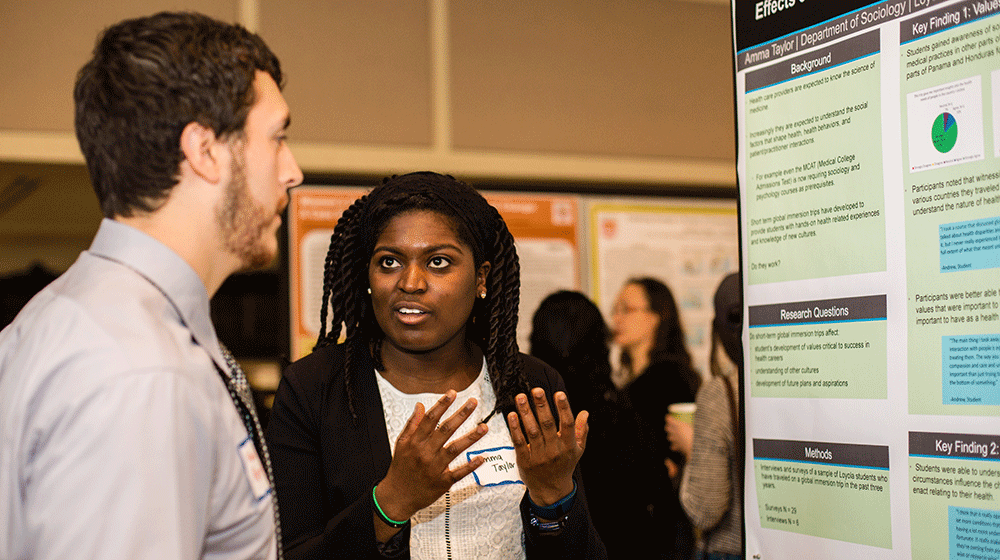
The Florida Undergraduate Research Conference (FURC) is one of the nation's largest multi-disciplinary research conferences. It is an annual event open to all undergraduate researchers in the state of Florida to present their research in a poster forum. Every year, the conference is hosted at a different college or university in the state. The conference boasts some of the best networking opportunities with fellow researchers and graduate programs across the country, as well as workshops and other professional development experiences.
Florida Undergraduate Research Conference
February 22-23, 2020
The Florida Undergraduate Research Conference (FURC) is one of the nation's largest multi-disciplinary research conferences. It is an annual event open to all undergraduate researchers in the state of Florida to present their research in a poster forum. Every year, the conference is hosted at a different college or university in the state. The conference boasts some of the best networking opportunities with fellow researchers and graduate programs across the country, as well as workshops and other professional development experiences.

Benefits of Undergraduate Research


-
Exposure to undergraduate research early in the college career increases students’ logical and critical thinking skills across a variety of disciplines throughout their college experience (Ishiyama, 2002, Houlden et al, 2004, Hernandez et al, 2013).
-
Undergraduate research experience cause increased gains in student achievement and persistence, especially for underrepresented groups (Parker, 2017, Jones et al, 2010).
-
Undergraduate research increases student retention for both first-year and transfer students when compared to similar students that do not participate in research activities (Stanford et al, 2017, Smith et al, 2016).
-
For science students, designing and executing a research project is associated with a stronger identity as a scientist (Hunter et al, 2007, Koontz Anthony et al, 2017).
-
Participation in undergraduate research experiences increases the likelihood of students pursuing a graduate degree (Eagan et al, 2013, Seymour et al, 2004, Bauer & Bennet, 2003).
-
Research experiences are a high-impact practice that can be integrated into a class, increasing accessibility to a broad range of students (Bangera et al, 2014, Brownell et al, 2015).
-
Engaging in undergraduate research projects increases students’ self-confidence and self-efficacy in designing and executing a scholarly or research project (Russell et al, 2007, Koontz Anthony et al, 2017).
-
Participation in research experiences as an undergraduate student increase students’ overall satisfaction with their undergraduate educational experience (Bauer & Bennet, 2003).
References
Bangera, G., & Brownell, S. E. (2014). Course-based undergraduate research experiences can make scientific research more inclusive. CBE—Life Sciences Education, 13(4), 602-606.
Bauer, K. W., & Bennett, J. S. (2003). Alumni perceptions used to assess undergraduate research experience. The Journal of Higher Education, 74(2), 210-230.
Brownell, S. E., Hekmat-Scafe, D. S., Singla, V., Chandler Seawell, P., Conklin Imam, J. F., Eddy, S. L., ... & Cyert, M. S. (2015). A high-enrollment course-based undergraduate research experience improves student conceptions of scientific thinking and ability to interpret data. CBE—Life Sciences Education, 14(2), ar21.
Eagan Jr, M. K., Hurtado, S., Chang, M. J., Garcia, G. A., Herrera, F. A., & Garibay, J. C. (2013). Making a difference in science education: the impact of undergraduate research programs. American educational research journal, 50(4), 683-713.
Hernandez, P. R., Schultz, P., Estrada, M., Woodcock, A., & Chance, R. C. (2013). Sustaining optimal motivation: A longitudinal analysis of interventions to broaden participation of underrepresented students in STEM. Journal of educational psychology, 105(1), 89.
Houlden, R. L., Raja, J. B., Collier, C. P., Clark, A. F., & Waugh, J. M. (2004). Medical students’ perceptions of an undergraduate research elective. Medical teacher, 26(7), 659-661.
Hunter, A. B., Laursen, S. L., & Seymour, E. (2007). Becoming a scientist: The role of undergraduate research in students' cognitive, personal, and professional development. Science education, 91(1), 36-74.
Ishiyama, J. (2002). Does early participation in undergraduate research benefit social science and humanities students?. College Student Journal, 36(3), 381-387.
Jones, M. T., Barlow, A. E., & Villarejo, M. (2010). Importance of undergraduate research for minority persistence and achievement in biology. The Journal of Higher Education, 81(1), 82-115.
Koontz Anthony, A., Walter, L., & McGrady, P. (2017) Creating connections between authentic research and the development of science identities in undergraduate Marine Biology experiences. Florida Scientist, 80(2), 61-75.
Parker, J. (2018). Undergraduate research, learning gain and equity: The impact of final year research projects. Higher Education Pedagogies, 3(1), 145-157.
Russell, S. H., Hancock, M. P., & McCullough, J. (2007). Benefits of undergraduate research experiences. Science, 316(5824), 548-549.
Seymour, E., Hunter, A. B., Laursen, S. L., & DeAntoni, T. (2004). Establishing the benefits of research experiences for undergraduates in the sciences: First findings from a three‐year study. Science education, 88(4), 493-534.
Smith, C., Schneider, K., & Johnson, J. (2016). The LEARN Consortium: A Three-institution Initiative to Impact STEM Retention of Freshmen and Transfer Students through Research Communities.
Stanford, J. S., Rocheleau, S. E., Smith, K. P., & Mohan, J. (2017). Early undergraduate research experiences lead to similar learning gains for STEM and Non-STEM undergraduates. Studies in Higher Education, 42(1), 115-129.


